What Are the Best Aftermarket Rubber Tracks from China?
Choosing the best aftermarket rubber tracks from China requires more than comparing prices or counting tread blocks. The right track must match the machine’s model, operating weight, sprocket design, and working surface. A compact excavator working in wet clay needs different performance from a tracked loader crossing hot asphalt.
Undercarriage specialist Mike Brezonick offers a useful warning: “A rubber track is only as good as its fit, compound, and working conditions.” That principle guides this review. We examine steel-cord construction, rubber quality, tread depth, pitch accuracy, sidewall strength, and supplier testing. These details matter when a track faces sharp gravel, frozen soil, or repeated turns beside a concrete foundation.
Several Chinese manufacturers now provide consistent molding, stronger internal cords, and clearer production records. However, quality is not uniform. A low-priced track may look convincing under bright warehouse lights, yet fail early through cord separation or uneven wear. That happens.
Real buyer experience also matters. We consider installation effort, vibration, warranty response, replacement availability, and technical support after delivery. Factory certificates help, but they should not replace sample inspection and field feedback. Some claims remain difficult to verify without long-term use. That limitation deserves honesty.
This guide compares leading aftermarket rubber tracks by durability, fit, value, and application suitability. It focuses on practical evidence, not broad promises. The best choice is rarely the cheapest one. It is the track that keeps the machine moving when the ground becomes rough, wet, and unforgiving.
What Are Aftermarket Rubber Tracks?
Aftermarket rubber tracks are replacement tracks made by an independent manufacturer, rather than the original equipment supplier. They fit excavators, mini loaders, and compact carriers. Their design usually matches the machine’s pitch, width, link count, and drive-lug shape. Quality also depends on steel-cord strength, rubber compound, tread depth, and curing control.
Off-Highway Research’s 2024 global review estimated construction-equipment sales at about 1.1 million units in 2023. That installed base creates strong replacement demand. A 2024 market assessment by Grand View Research also reported continued growth in rubber-track demand, driven by compact equipment and rental fleets. Chinese aftermarket tracks can offer competitive pricing and broad size coverage. However, lower cost does not always mean lower lifetime cost. Poor lug alignment can cause vibration, uneven wear, or derailment. No choice is perfect. Soil, operator habits, and undercarriage condition still matter.
Tips: Measure the old track before ordering. Record width, pitch, and link count. Check the sprocket and rollers for sharp wear. Ask for compound details, production inspection records, and a written warranty. A short field test on concrete, gravel, and wet soil can reveal weaknesses quickly. One practical mistake is trusting appearance alone; a deep tread may still hide weak steel cords.
How Chinese Rubber Track Manufacturers Compare
Chinese rubber track manufacturers compete strongly on price, production capacity, and customization.
Grand View Research valued the global construction equipment market at about USD 232 billion in 2023. It also projects continued growth through 2030. This expansion supports more aftermarket demand for mini excavators, loaders, and access platforms.
Price is only one comparison point. Serious manufacturers should provide compound specifications, steel-cord details, tread drawings, and batch traceability. Their factories should show mixing, molding, tension testing, and final inspection records. ISO 9001 certification helps, but it does not prove track durability. Ask for test results covering abrasion, heat aging, and tensile strength. ASTM and ISO-based methods can make supplier comparisons less subjective.
Field experience still matters.
A track may look excellent on delivery yet fail early on sharp demolition debris. Another may last longer on soft soil but wear quickly on concrete. Reports from industry researchers, including Off-Highway Research, consistently link equipment utilization and operating conditions with replacement demand. Therefore, compare manufacturers using the same machine, terrain, load, and working hours. Review warranty exclusions carefully. Some suppliers offer attractive coverage, but installation errors or incorrect tension may void it. I have found that unclear technical drawings often signal future service problems. That judgment is imperfect, yet it deserves attention. Freight distance, spare-part response, and communication quality also affect the real aftermarket cost. A lower quotation can become expensive when one replacement track arrives late.
Which Features Determine Track Quality and Durability?
When choosing aftermarket rubber tracks from China, inspect the compound before comparing prices. A durable track uses a balanced rubber formulation, not simply harder rubber. Natural and synthetic rubber, carbon black, and anti-ozonants must work together. Too-soft rubber grips well but wears quickly on gravel. Too-hard rubber may crack around the guide lugs. Ask for compound test data, but read it critically. Laboratory numbers can miss field abuse.
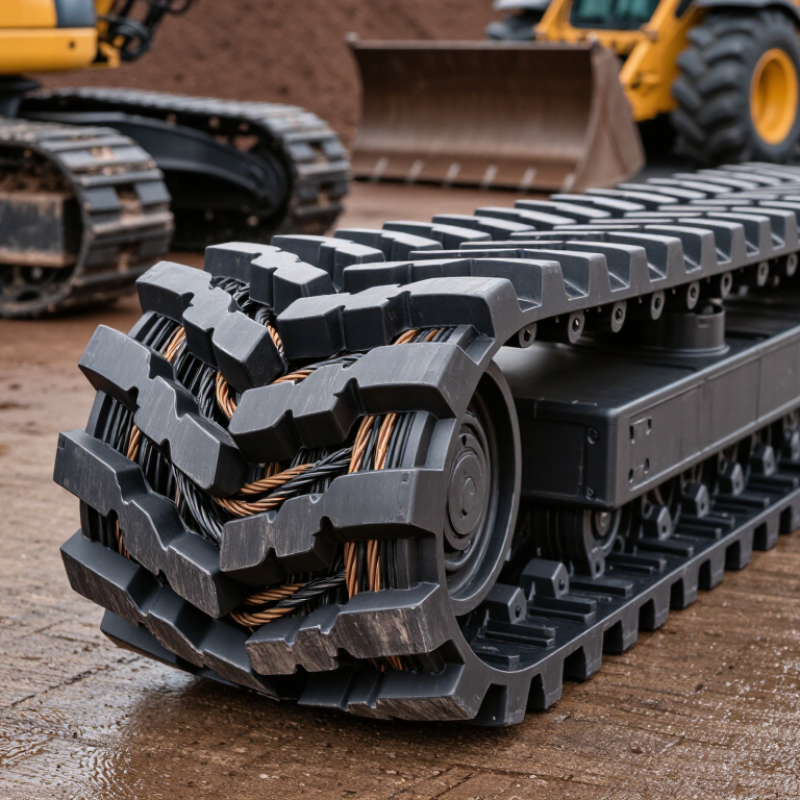
The internal steel cords are equally important. They should run evenly, with strong adhesion between rubber and metal. Look for consistent pitch, clean molding, and reinforced edges. A track with exposed cords or uneven lug height is already a warning. Measure lug wear after known operating hours. This is more useful than a sales promise. Check the guide lugs against your machine’s sprocket and roller dimensions. Small mismatches create heat, vibration, and fast wear. Tension matters, too. An over-tightened track can damage bearings and shorten service life.
In my equipment checks, trapped stones caused more trouble than expected. Remove them before road travel. Mud and sharp debris reveal weak sidewalls quickly. I once accepted a low-cost set after a brief visual inspection, and the edges chipped within weeks. That mistake changed my buying routine. I now request curing records, batch traceability, warranty terms, and sample measurements. Not every supplier provides complete evidence. That is worth noticing. A careful trial on the actual machine remains the fairest durability test.
What Are the Best Aftermarket Rubber Tracks from China?
Features That Determine Track Quality and Durability
The chart presents a practical screening-weight model for evaluating aftermarket rubber tracks. Rubber compound performance and steel-cord bonding are critical because they influence resistance to heat, ozone, tearing, stretching, and premature separation. Tread design, correct undercarriage fit, carcass construction, and manufacturing consistency also have a direct effect on traction, vibration, wear life, and operating reliability. The percentages are evaluation weights rather than laboratory test results, so the final selection should also consider the machine model, operating surface, load, climate, and supplier test documentation.
How to Select a Reliable Chinese Track Supplier
Choosing a reliable Chinese track supplier requires more than comparing price lists. Grand View Research’s 2024 construction equipment analysis identifies Asia-Pacific as the largest regional market. This reflects strong production capacity, but capacity is not proof of quality. Ask for factory photographs, production records, and recent test reports. A dependable supplier should explain rubber compound, steel-cord treatment, tread design, and machine compatibility clearly. Vague answers are warning signs.
I inspect sample tracks for uneven lugs, exposed cords, and poor edge finishing. Request tensile, tear, abrasion, and ozone-resistance results using recognized ASTM or ISO test methods. Check whether each batch has a traceable code. ISO 9001 certification can support process control, but it cannot replace independent testing or field experience. The 2024 Freedonia analysis of global rubber products also highlights replacement demand as a major market driver. That makes warranty terms important. A short warranty may hide inconsistent compounds or weak cord bonding.
Tips: Compare three suppliers using the same specification sheet. Request a sample before ordering. Measure pitch, width, link count, and guide design carefully. Confirm delivery dates in writing. Ask for references from similar machines and operating conditions. I once treated a low quote as the best offer; transport and premature wear changed that judgment. Cost matters, but downtime matters more. Try a limited trial order first. Inspect performance after several hundred working hours. Supplier selection is never perfectly certain. Surface conditions, operator habits, and storage can still affect track life.