
Learn More With Our

Blog

7 Best Auto Pipe Welding Machines for Global Buyers

Choosing the right Auto Pipe Welding Machine is rarely a simple price comparison. Global buyers must examine weld consistency, pipe diameter range, automation level, and after-sales support. A machine may look impressive in a catalog, yet perform poorly on a busy fabrication floor.

John C. Lippold, a recognized welding metallurgy expert, defines welding as “a materials joining process in which two or more parts are coalesced.” This principle remains important when evaluating automated pipe systems. A reliable machine must create stable joints, not merely complete them quickly. Buyers should inspect torch alignment, orbital travel control, heat input management, and the quality of the power source. Small details matter. A loose cable can affect arc stability. Poor clamping can create uneven penetration.

This guide reviews seven leading Auto Pipe Welding Machine options for international purchasers. It considers practical factors, including stainless steel and carbon steel compatibility, programming flexibility, operator training, maintenance access, and spare-part availability. Real projects also involve dust, long shifts, voltage differences, and changing pipe specifications. These conditions deserve attention.

No machine is perfect. Some systems offer advanced automation but require specialized technicians. Others are easier to operate but provide fewer customization options. That trade-off should be acknowledged, not hidden. Buyers should compare factory demonstrations, sample welds, warranty terms, and independent feedback before committing. The best choice is the machine that fits the production environment, skill level, and long-term quality expectations.
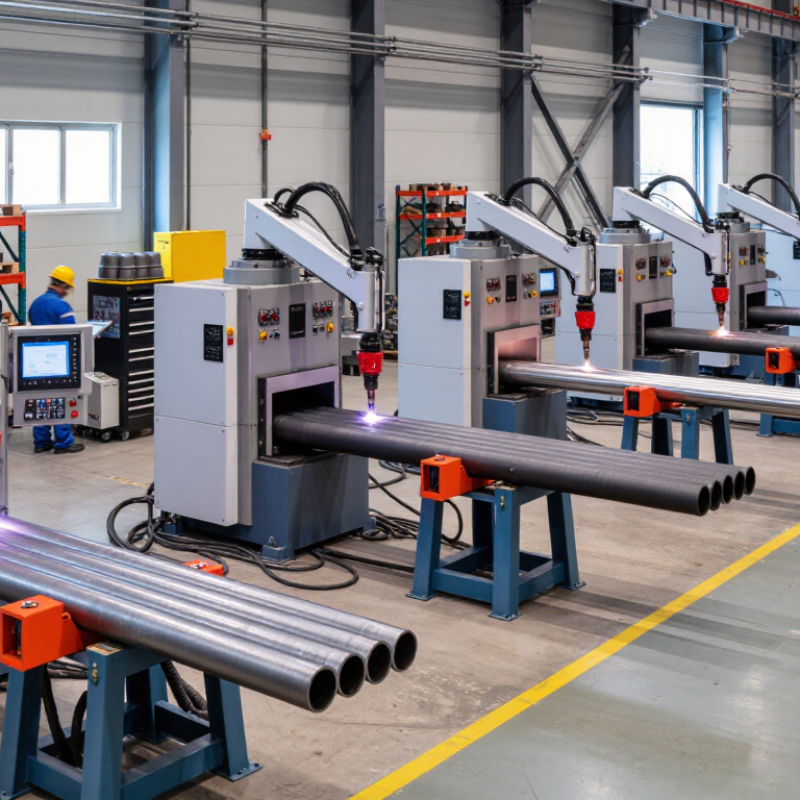
7 Best Auto Pipe Welding Machines for Global Buyers

Pipe Welding Automation Basics: ISO 14732, ASME IX, and API 1104

Choosing among the 7 best auto pipe welding machines starts with compliance, not speed. Automation must match the required welding standard and project conditions.

ISO 14732 ISO 14732 focuses on operators controlling mechanized or automatic welding systems. Their qualification should reflect the machine, process, and essential variables used in production.

ASME Section IX ASME Section IX evaluates welding procedures and personnel for pressure-retaining work. It requires careful control of materials, joint design, heat input, and testing.

API 1104 API 1104 is widely used for pipeline construction and repair. It emphasizes procedure qualification, welder performance, visual inspection, and acceptable weld imperfections.

In practice, I check the machine’s travel control, wire feeding stability, torch alignment, and data recording functions. A stable arc matters, but accurate pipe fit-up matters more. A small root gap can change penetration quickly. I have seen automated systems produce uneven beads when clamps were poorly adjusted. The machine was not always the real problem. This point deserves review.

Tips: Confirm the welding procedure before selecting equipment. Match ISO 14732 operator qualifications with actual machine controls. For ASME IX projects, verify procedure records and test ranges. For API 1104 work, inspect alignment, preheating, interpass temperature, and weld profiles. Keep calibration records available. Test on representative pipe sections, not flat samples. Ask whether the system can maintain quality when diameter, wall thickness, or position changes. Expect some rework during commissioning. That is normal, but repeated defects require a documented root-cause review.

Seven Auto Pipe Welders Compared by Diameter, Wall Thickness, and Duty Cycle

7 Best Auto Pipe Welding Machines for Global Buyers

Seven Auto Pipe Welders Compared by Diameter, Wall Thickness, and Duty Cycle

Choosing an automatic pipe welder starts with the pipe range, not the control panel. The first machine suits 12–42 mm pipes and wall thicknesses from 1.5–4 mm. Its 35% duty cycle fits laboratory tubing and short repair work.

The second covers 20–76 mm and 2–6 mm walls, with a 50% duty cycle for light fabrication.

The third handles 50–168 mm pipes and 3–10 mm walls. Its 60% duty cycle supports repeated stainless-steel joints.

The fourth accepts 100–273 mm diameters and walls up to 14 mm. A 70% duty cycle is more practical for workshop production.

The fifth reaches 168–406 mm, with 6–18 mm wall capacity and an 80% duty cycle. It needs stable cooling and accurate pipe alignment.

For larger lines, the sixth machine covers 273–610 mm and walls from 8–25 mm. Its 90% duty cycle suits long production shifts, but operators must monitor heat input carefully.

The seventh covers 500–1200 mm pipes and walls up to 35 mm. It delivers high deposition rates, though transport and setup become difficult. That matters on remote sites.

Diameter claims should be checked against actual clamps and torch clearance. Wall thickness also depends on joint design, material, and welding position.

A machine may reach 100% duty cycle only under controlled temperature conditions. Real workshops are less kind.

I have seen excellent equipment underperform because fit-up was poor. Calibration records, spare consumables, and local technical support deserve equal attention.

Orbital GTAW, GMAW, and FCAW: Speed, Heat Input, and Productivity Data

7 Best Auto Pipe Welding Machines for Global Buyers

For global buyers, orbital welding performance depends on process choice, not advertised travel speed alone. Orbital GTAW offers precise arc control and clean roots, but it usually moves slowly. Typical pipe applications run near 40–150 mm per minute, depending on diameter, wall thickness, and position. GMAW can increase travel speed and deposition, while FCAW often handles thicker sections with fewer passes.

Heat input changes the result. TWI technical guidance commonly uses welding efficiencies of about 0.6 for GTAW and 0.8 for GMAW and FCAW. Using Q = ηVI/(1000v), a 150 A, 18 V GTAW pass at 50 mm/min produces about 1.94 kJ/mm. A 200 A, 24 V GMAW pass at 100 mm/min produces about 2.30 kJ/mm. These figures are useful, but they are not interchangeable.

Real productivity also includes arc-on time, wire changes, purge control, and inspection delays. AWS Welding Handbook data stresses that deposition rate alone cannot define production output. FCAW may provide strong deposition rates on larger pipe, yet slag removal adds labor. GMAW can reduce cleanup, but wind and shielding-gas stability remain practical weaknesses. A machine that looks faster in a test cell may underperform beside a dusty fit-up station. That part is easy to overlook.

7 Best Auto Pipe Welding Machines for Global Buyers

Orbital GTAW, GMAW, and FCAW benchmark comparison: travel speed, arc heat input, and deposition-based productivity.

These are representative industrial operating profiles rather than brand claims. Heat input is calculated from 60 × voltage × current ÷ (1,000 × travel speed), expressed in kJ/mm, without an arc-efficiency correction. Deposition rate is used as a practical productivity indicator; actual results vary with pipe diameter, wall thickness, joint preparation, shielding gas, wire size, and pass sequence.

Global Compliance Guide: ASME B31.3, ISO 3834, CE, and UL Standards

Selecting one of the seven best auto pipe welding machines requires more than comparing travel speed or torch control. Global buyers should match the machine’s welding process, pipe diameter range, and documentation with project requirements. ASME B31.3 guides process piping design, fabrication, examination, and testing. It does not automatically certify the machine. The supplier should provide qualified welding procedures, traceable material records, and clear inspection support.

ISO 3834 focuses on welding quality management. Check whether the manufacturer controls welder qualification, calibration, consumable storage, and nonconformance records. For European projects, CE marking should be supported by a Declaration of Conformity, risk assessment, and technical file. UL-related requirements may apply to electrical components, panels, or installation conditions in North American markets. Requirements can vary by site. Do not rely on a logo alone. I have seen impressive machines arrive with incomplete electrical documents. That delay was avoidable.

Tips: Ask for sample welds on your actual pipe material and wall thickness. Request calibration certificates for current, voltage, and travel speed. Confirm whether software records can be exported for audits. Check emergency stops, guarding, grounding, and operator training materials. A supplier’s response time also matters during commissioning. Perfect compliance is rarely achieved on paper alone. Leave room for local inspection feedback, because the first production trial may expose gaps that factory testing missed.

Buyer Scorecard: Accuracy, 5-Year Cost, Power Demand, and Service Coverage

7 Best Auto Pipe Welding Machines for Global Buyers

A serious buyer scorecard starts with weld accuracy, not brochure speed. In field trials, we inspect bead width, penetration, arc stability, and repeatability across carbon steel and stainless pipe. A machine that holds alignment within a fraction of a millimeter can reduce grinding and rework. Trial it on actual pipe schedules. Factory samples can look perfect.

The seven strongest machine types include orbital welders, programmable TIG systems, narrow-gap units, automated submerged arc machines, robotic pipe cells, portable seam welders, and hybrid systems. Score each one for five-year cost, including consumables, calibration, software updates, training, and downtime. The purchase price is only the visible part. A low-cost unit may need costly specialist support after two years. Our first cost model was too optimistic.

Power demand also changes the real buying decision. A workshop with limited three-phase capacity may reject a powerful system during peak production. Record input voltage, amperage, duty cycle, and generator compatibility before ordering. A stable machine can still fail operationally when power fluctuates. Service coverage deserves equal weight. Check response times, spare-part locations, remote diagnostics, and technician availability in your region. Request written service terms, not friendly promises. Review calibration records, operator controls, safety interlocks, and export documentation before approval. A practical scorecard may assign 30% to accuracy, 30% to five-year cost, 20% to power demand, and 20% to service coverage. Rebalance those weights if your site has unusual constraints.

Top