


Choosing a Tile Laser Cutting Machine in 2026 requires more than comparing wattage and price. Tile shops now handle porcelain, ceramic, glass, stone, and large-format slabs. Each material reacts differently to heat, speed, and beam focus. A machine that cuts clean porcelain may chip glass or leave dark edges on polished stone. The right choice begins with your actual products, daily workload, and finishing expectations.
Practical evaluation should include cutting tests with your own tiles. Request samples using textured surfaces, glazed edges, and narrow strips. Watch for corner cracks, heat marks, uneven kerfs, and dust control during operation. Check the machine’s working area against your largest tile, not your average one. A 1,300 × 900 millimeter bed may sound generous, but it can feel restrictive with oversized slabs. Small details matter.
Reliable buying decisions also depend on technical evidence. Review laser power, motion accuracy, cooling, extraction, software compatibility, warranty coverage, and spare-part access. Ask whether local technicians can support calibration after installation. Manufacturer claims are useful, but independent demonstrations are more revealing. Some advertised speeds may require reduced quality or repeated passes. That trade-off is easy to overlook.
This guide examines the factors that deserve careful attention when selecting a Tile Laser Cutting Machine for 2026. It also recognizes an uncomfortable truth: no machine is perfect for every workshop. Budget limits, operator skill, floor space, and maintenance discipline can change the final result. Choose based on measurable performance, not impressive brochures. Think long term.
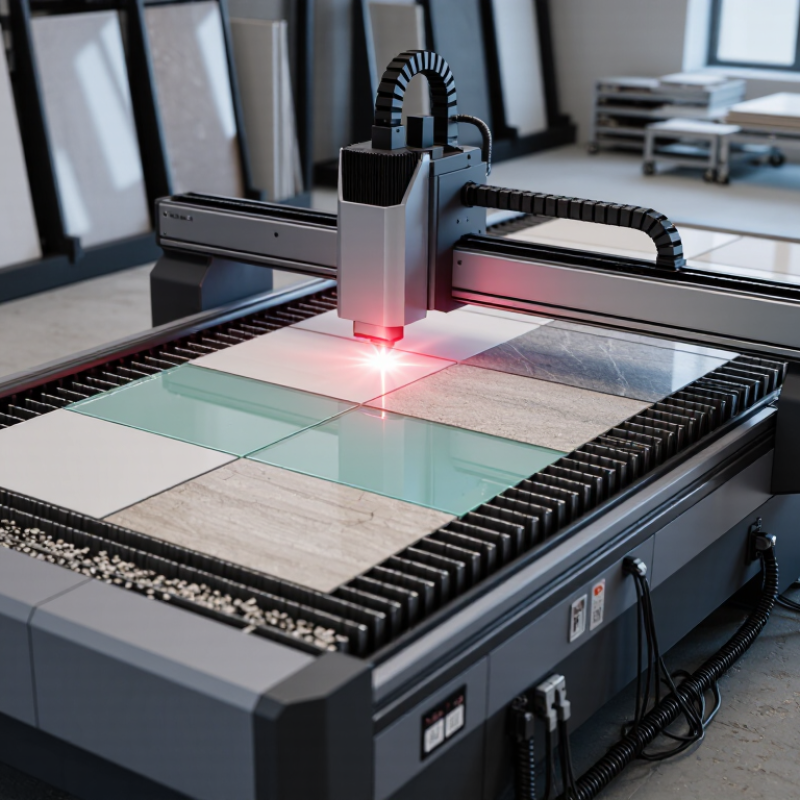
Before choosing a tile laser cutting machine in 2026, identify the material precisely. Ceramic tiles are usually softer and more porous than porcelain. Porcelain is denser, harder, and often less forgiving around edges. A glossy glaze may reflect energy or chip under uneven heat. Do not judge material by color alone. Check the technical sheet, water absorption, glaze type, and backing structure.
Thickness changes the cutting strategy. Tiles from 3 to 6 mm may need modest power and careful speed control. At 10 mm, heat buildup becomes more noticeable. Tiles between 15 and 20 mm require stronger energy delivery, stable focusing, and effective dust extraction. A narrow kerf is useful, but edge quality matters more than speed. Ask for test cuts using your actual tile batch. Samples can reveal hidden voids, mesh backing, or internal stress.
Measure the cut edge under bright light. Look for corner breakout, dark heat marks, glaze lifting, and uneven depth. A machine with adjustable power, pulse frequency, focus height, and travel speed gives better control across mixed orders. Operators should record successful settings instead of relying on memory. That sounds simple. It is not.
Some recommendations may fail on a different glaze or thickness. Recheck them. A 20 mm porcelain tile may need multiple passes, while another tile may crack after one aggressive pass. Leave room for testing, maintenance, and operator training when comparing machine specifications.
Technical selection guide for fired tiles and ceramic slabs. Actual performance depends on tile formulation, glaze, reinforcement, beam quality, cooling, optics, and required edge quality.
| Tile Material | Typical Thickness | Material Characteristics | Laser Compatibility | Recommended Laser Architecture | Indicative Source Range | Recommended Process | Main Risks |
|---|---|---|---|---|---|---|---|
| Standard Ceramic Wall Tile | 3–6 mm | Relatively porous clay body with a glazed or unglazed surface; lower density than porcelain. | Moderate to good for straight cuts and openings | Sealed CO₂ system with stable beam delivery, extraction, and a rigid motion platform. | Approximately 100–200 W continuous-wave CO₂ | Use low-to-moderate feed speed, air or inert-gas assistance where appropriate, and multiple passes for cleaner edges. | Glaze discoloration, edge chipping, localized thermal cracking, and dust contamination. |
| Glazed Ceramic Floor Tile | 6–10 mm | Denser body and harder surface than wall tile; the glaze may respond differently from the ceramic substrate. | Moderate; sample testing is essential | CO₂ laser with adjustable focus, closed-loop height control, fume extraction, and effective workholding. | Approximately 150–300 W continuous-wave CO₂ | Prefer several controlled passes rather than one aggressive pass; use masking or a sacrificial support surface when needed. | Glaze flaking, heat-affected marks, microcracks, and nonuniform penetration caused by body-density variation. |
| Unglazed Ceramic Tile | 5–10 mm | Open surface structure can absorb dust and moisture; the body is generally more tolerant of surface marking than a decorative glaze. | Moderate to good, depending on density | CO₂ laser with strong extraction, autofocus or height sensing, and a flat, low-vibration bed. | Approximately 150–300 W continuous-wave CO₂ | Use gradual energy input and inspect the underside for breakthrough quality; compressed air can help remove debris. | Powder buildup, porous-edge erosion, uneven kerf width, and breakage during unloading. |
| Porcelain Tile | 6–12 mm | Highly vitrified, low-absorption ceramic with high density and hardness; it usually requires more energy and better thermal control. | Limited to moderate for production cutting | High-stability CO₂ platform with precision focusing, multi-pass control, robust extraction, and active workpiece cooling where applicable. | Approximately 200–500 W continuous-wave CO₂, subject to testing | Use low heat accumulation per pass, controlled dwell time, and trial coupons to determine acceptable speed and overlap. | Thermal shock, hidden microcracks, chipped corners, and unacceptable backside breakout. |
| Porcelain Tile | 12–20 mm | Very dense and brittle fired body; some large-format products include reinforcement or internal stress from firing. | Difficult for full-depth laser cutting | Specialized high-power CO₂ or hybrid laser process only after application trials; a conventional engraving machine is generally unsuitable. | Typically above 300 W CO₂ for experimental full-depth work; power alone does not ensure quality. | Consider scoring, controlled multi-pass removal, water-assisted thermal management, or a laser-plus-mechanical finishing process. | Severe cracking, delamination, excessive heat-affected zones, slow throughput, and high scrap rates. |
| Decorative Ceramic Mosaic | 3–8 mm | Small-format pieces may have colored glazes, textured faces, mesh backing, or adhesive layers. | Moderate for individual pieces | CO₂ laser with precise low-power modulation, vision alignment, and separate settings for tile body and backing. | Approximately 60–150 W CO₂ for thin individual pieces, subject to composition | Test the face, edge, adhesive, and mesh separately; use extraction designed for adhesive and coating fumes. | Color change, adhesive smoke, mesh ignition, small-part movement, and inconsistent focus. |
| Large-Format Ceramic Slab | 6–12 mm | Large dimensions increase handling difficulty and may amplify vibration, flatness, and thermal-stress problems. | Moderate for detail work; challenging for full-length cuts | Large-format gantry, automatic height mapping, multiple support zones, high-capacity extraction, and calibrated beam alignment. | Approximately 200–500 W CO₂ for trials; final sizing requires material tests. | Verify flatness, clamp or support the slab uniformly, and use a staged cutting path to limit stress concentration. | Slab movement, corner fracture, long-cycle heat accumulation, alignment drift, and handling damage. |