


Choosing an aluminum scrap melting furnace in 2026 requires more than comparing purchase prices. Scrap quality changes daily. One batch may contain clean extrusion offcuts, while the next includes painted sheets, oil residue, or mixed castings. These differences affect melting speed, metal recovery, emissions, and maintenance.
A suitable aluminum scrap melting furnace should match your scrap profile, production volume, alloy requirements, and available energy source. Gas-fired, electric, and hybrid systems each offer practical advantages. The right choice depends on operating conditions, not fashionable specifications. Chamber design, refractory durability, burner control, heat recovery, and filtration deserve close attention. So does the furnace door. A poorly sealed door can waste heat every hour.
In plant evaluations, operators often focus on rated capacity first. That can be a costly mistake. A furnace rated for five tons may perform poorly with bulky, contaminated, or wet scrap. Loading equipment, dross handling, temperature measurement, and automatic controls also influence real output. Small details matter.
Safety and environmental performance must remain central. Buyers should verify supplier documentation, testing procedures, service capability, and compliance with applicable local requirements. Ask for measurable data, such as fuel consumption per ton, melt loss, heat-up time, and expected refractory life. Do not rely only on brochures.
The best decision may not be the cheapest furnace. It should provide stable metal quality, predictable operating costs, and manageable maintenance. Still, every forecast has uncertainty. Actual performance depends on scrap preparation and operator discipline. This guide explains the main selection criteria and the questions worth asking before signing a purchase agreement.
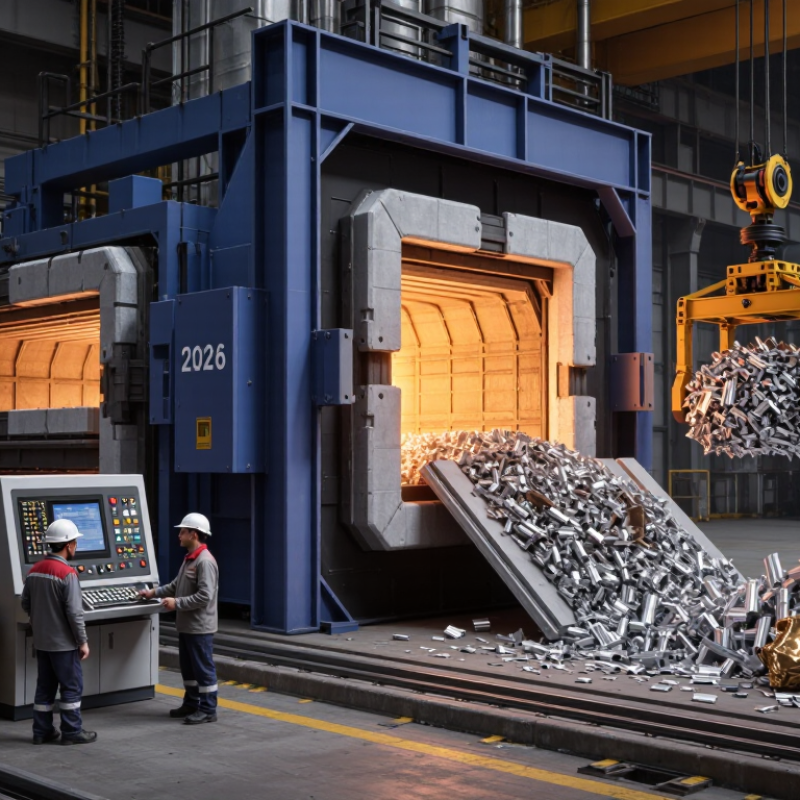
How to Choose an Aluminum Scrap Melting Furnace in 2026?
Define your aluminum scrap before comparing furnace prices. Wrought sheet, extrusion offcuts, castings, turnings, and mixed scrap melt differently. Turnings may carry oil and trap moisture. Coated sheet can increase dross and fume control needs. Cast scrap often contains more silicon, iron, and other alloying elements. A furnace designed for clean, dense scrap may perform poorly with loose, contaminated feed.
Set measurable processing goals. Do you need high recovery, rapid melting, stable alloy chemistry, or flexible batch sizes? The International Aluminium Institute reports that recycled aluminum can require up to 95% less energy than primary aluminum production. That advantage can disappear with excessive dross, poor loading, or long holding times. The USGS Mineral Commodity Summaries 2025 estimated global primary aluminum production at about 72 million metric tons in 2024. This scale increases pressure to recover scrap efficiently, but efficiency should not replace metal quality.
Tips: Test a representative load, not a perfect sample. Record charge density, moisture, melt loss, cycle time, dross percentage, and electricity use. Ask whether the furnace supports your actual alloy range. A neat specification can still mislead. I would also inspect charging access, fume capture, lining wear, and maintenance time. These details often decide operating cost. Recheck assumptions after three production cycles. Scrap changes, sometimes more than expected.
| Aluminum Scrap Type | Typical Examples | Common Preparation Requirements | Main Processing Risk | Recommended Furnace Characteristics | Typical Metal Recovery Range* | Best-Matched Processing Goal | Overall Suitability |
|---|---|---|---|---|---|---|---|
| Clean extrusion offcuts | Unpainted profile cuttings, fabrication offcuts and short lengths with limited attachments | Remove steel fasteners and non-aluminum parts; keep the material dry; compact long or lightweight pieces when necessary | High surface-area oxidation and low bulk density can increase dross formation and reduce furnace productivity | Well-sealed gas-fired or electric resistance furnace with controlled charging, low turbulence and sufficient bath depth | Approximately 94–98% | High-quality remelting, alloy control and efficient production of standard cast billets or ingots | Excellent |
| Painted or coated extrusion scrap | Architectural profiles, coated window-frame sections and powder-coated production scrap | Remove large steel components; preheat or thermally decoat when required; provide exhaust treatment for coating decomposition products | Organic coatings generate smoke, volatile compounds and additional dross; coating residues may affect metal cleanliness | Furnace with controlled preheating or decoating, strong off-gas handling, temperature control and skimming access | Approximately 90–96% | High-throughput recycling while controlling emissions and maintaining repeatable alloy chemistry | Good with controls |
| Clean sheet and plate scrap | Manufacturing trim, blanking skeletons and unpainted sheet offcuts | Sort by alloy family; remove oils, plastics and ferrous pieces; bale or compact thin sheet where practical | Thin pieces oxidize quickly and may bridge over the charge; mixed alloys can cause chemistry deviations | Fast-charging furnace with a controlled melting zone, efficient circulation and accurate temperature measurement | Approximately 92–97% | Stable batch production with good yield and predictable alloy composition | Excellent |
| Mixed cast aluminum scrap | Cast housings, pump bodies, automotive castings and mixed foundry returns | Remove steel inserts, sand, oil and attached components; separate heavily contaminated or magnesium-rich items where possible | Sand, iron and oil contamination increases slag, refractory wear and alloy-quality variation | Tilting or rotary furnace with effective slag removal, robust refractory lining and flexible charge handling | Approximately 88–95% | Cost-effective remelting of variable feedstock for secondary alloy production | Excellent |
| Aluminum beverage cans | Used beverage containers and baled post-consumer can scrap | Drain liquids; remove excessive foreign material; shred or densify when appropriate; use thermal decoating and exhaust treatment | Very high surface-to-volume ratio, coatings, moisture and mixed packaging can cause oxidation, smoke and charging instability | Rotary or dedicated can-melting system with decoating capability, rapid submergence, strong off-gas control and efficient dross management | Approximately 85–93% | High-volume recycling with controlled emissions and recovery of thin-gauge scrap | Good with controls |
| Aluminum turnings and machining chips | Loose or compacted chips from turning, milling, drilling and sawing operations | Remove tramp metal; drain cutting fluids; briquette or compact loose chips; keep moisture out of the charge | Large exposed surface area causes rapid oxidation; residual moisture can create a serious molten-metal safety hazard | Chip-specific rotary or vortex-melting furnace with controlled charging, chip submergence and moisture safeguards | Approximately 80–92% | Recovering valuable machining scrap while reducing chip storage and transportation volume | Good with controls |
| Aluminum foil and thin-gauge scrap | Foil trim, laminated foil, thin sheet and lightweight packaging-related aluminum | Separate paper, plastic and laminates; remove moisture; compact or briquette the material before charging | Extremely high oxidation losses and rapid formation of dross; attached organic material increases emissions | Furnace designed for rapid submergence, low-turbulence melting, controlled atmosphere or decoating and frequent dross removal | Approximately 70–90% | Specialized recovery where the feedstock is available in sufficient volume to justify preparation equipment | Good with controls |
| Oil- or lubricant-contaminated scrap | Machining parts, oily turnings, press-shop scrap and production residues with cutting-fluid contamination | Drain, centrifuge, wash or thermally dry as appropriate; verify moisture removal and provide vapor treatment | Smoke, volatile emissions, fire risk and unstable melting behavior; wet scrap can cause violent metal-water reactions | Pre-treatment system combined with a furnace offering controlled preheating, exhaust treatment and monitored charging | Approximately 80–94% | Safe recovery of industrial scrap while limiting emissions and minimizing material loss | Good after pre-treatment |
| Mixed post-consumer aluminum | Household and commercial aluminum packaging, mixed utensils and assorted consumer scrap | Sort by material and alloy where feasible; remove plastics, glass, steel, liquids and hazardous residues; shred or densify | Variable contamination, uncertain alloy chemistry, moisture and high non-metal content reduce yield and product consistency | Flexible rotary or reverberatory-style system with robust charging, advanced sorting upstream and comprehensive off-gas control | Approximately 75–90% | Maximum feedstock flexibility and recovery of low-grade scrap at controlled operating cost | Good with controls |
| High-magnesium aluminum scrap | Selected wrought or cast scrap containing relatively high magnesium levels | Identify alloy family; avoid uncontrolled mixing; monitor chemistry using sampling and spectrometric analysis where required | Excess magnesium can change alloy performance and may increase oxidation or dross depending on operating conditions | Furnace with accurate temperature control, controlled atmosphere or flux practice and reliable alloy-adjustment capability | Approximately 90–96% | Producing a consistent secondary alloy rather than simply maximizing furnace throughput | Good with chemistry control |
| Ferrous-attached or heavily contaminated scrap | Aluminum assemblies with steel inserts, mixed metal components and scrap containing substantial dirt or attachments | Use magnets, eddy-current separation, dismantling, shredding and cleaning; reject hazardous or excessively contaminated material | Iron pickup, refractory damage, excessive slag, lower yield and difficult alloy-quality control | Pre-sorting equipment plus a furnace with strong slag management, durable lining and frequent bath-quality inspection | Approximately 60–88% | Processing difficult, low-cost feedstock when preparation and sorting capacity are available | Limited without preparation |
| Dross and salt slag residues | Oxide-rich residues generated during aluminum melting and skimming operations | Store dry; classify and process separately; use dedicated dross treatment or external recovery; do not charge as ordinary clean scrap | High oxide content, possible salt content, dust generation and limited recoverable metallic aluminum | Dedicated dross-processing equipment or specialized recovery route rather than a conventional primary scrap-melting furnace | Approximately 20–70%, depending on metallic content and treatment method | Recovering entrained metallic aluminum and reducing waste-disposal volume | Specialized system required |
*Recovery ranges are typical planning estimates for well-operated systems and can vary with scrap size, oxidation, moisture, coatings, contamination, alloy mix, charging practice, furnace design and dross-management procedures. All wet, sealed, pressurized or hazardous items should be excluded or professionally prepared before charging.