


A Scooter Sport Bike blends scooter practicality with the sharper responses of a performance motorcycle. The term is not perfectly standardized. Manufacturers, riders, and journalists may use it differently. Usually, it describes a step-through scooter with stronger acceleration, firmer suspension, larger brakes, and sport-focused bodywork.
Piaggio chairman Roberto Colaninno once described the scooter as “the most democratic means of transport.” That idea still matters. A Scooter Sport Bike can carry a rider through crowded streets, then feel composed on a winding road. Its usefulness comes from the details. The rider twists the throttle. The engine turns a continuously variable transmission, or CVT. The CVT changes its ratio without manual gear shifts. A centrifugal clutch then transfers power to the rear wheel.
The experience is more physical than a specification sheet suggests. You feel the transmission tighten its response when the road rises. You notice the front suspension compress under braking. Wide tires add stability, although they cannot replace careful riding. Many models also use traction control, fuel injection, and anti-lock braking systems. These features support control, but they do not remove risk.
Engine size alone does not define this category. Weight, wheel design, chassis balance, and tuning often matter more. Some scooters feel genuinely sporty. Others mainly wear aggressive styling. That distinction deserves attention. In this guide, we will examine how a Scooter Sport Bike works, what its components do, and where its practical limits remain. The answer is not always simple. That is part of the appeal.
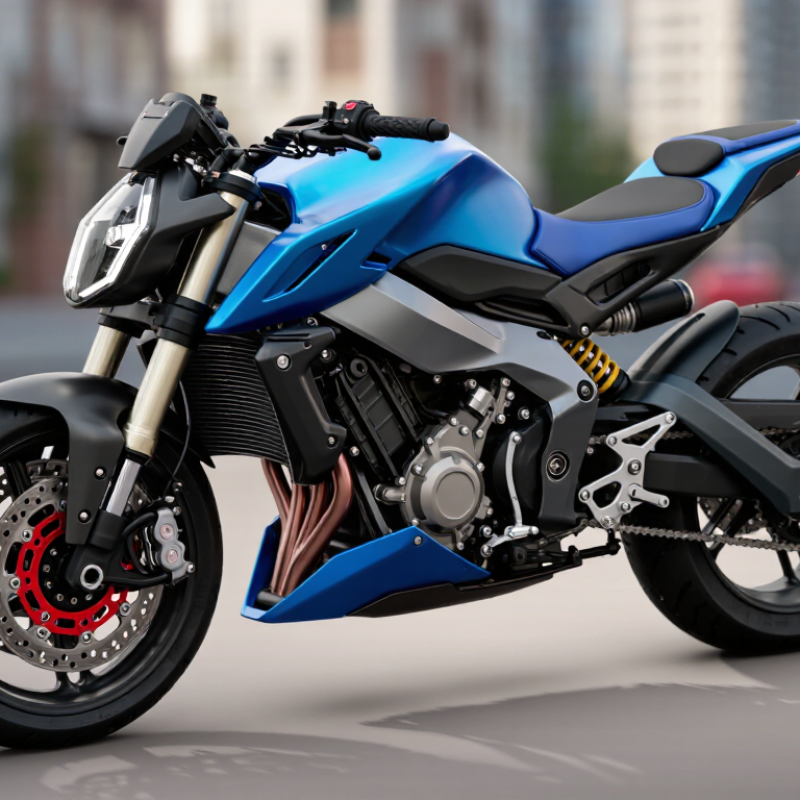
What Is a Scooter Sport Bike and How Does It Work?
A scooter sport bike is a practical scooter with sharper styling, stronger brakes, and responsive handling. The phrase is informal, not a separate legal vehicle class. Under EU Regulation (EU) 168/2013, classification depends on measurable specifications, not sporty bodywork.
L1e covers two-wheeled mopeds. In general, these vehicles have a maximum design speed of 45 km/h. Their combustion engines are limited to 50 cc, while electric versions usually remain within the regulation’s power limits. L3e covers two-wheeled motorcycles. These vehicles exceed L1e limits and can include automatic scooters with larger engines or more powerful electric systems. The rider uses a throttle, transmission, brakes, and suspension much like other powered two-wheelers. A belt-driven continuously variable transmission often adjusts speed smoothly. It feels simple, but maintenance still matters.
Tips: Check the vehicle’s certificate of conformity before purchase. Look for its exact L-category, rated power, maximum speed, and approved mass. Registration and licensing requirements can differ between EU member states. Ask a qualified inspection office when details seem unclear. I have seen sporty panels create confusion. Appearance alone proves very little. Temperature, tire pressure, and battery condition can also change real-world performance. That part is easy to overlook.
| Data Dimension | L1e Category | L3e Category | Practical Meaning for a Scooter Sport Bike |
|---|---|---|---|
| Legal vehicle group | Two-wheel moped or powered cycle within the L-category vehicle framework. | Two-wheel motorcycle within the L-category vehicle framework. | “Scooter sport bike” is a descriptive market term, not a separate EU legal vehicle category. |
| Maximum design speed | Generally up to 45 km/h for L1e-B two-wheel mopeds. L1e-A powered cycles are limited to 25 km/h. | Above the L1e speed limit, typically more than 45 km/h. | A performance-oriented scooter capable of exceeding 45 km/h normally falls into L3e rather than L1e. |
| Internal-combustion engine limit | For L1e-B, engine cylinder capacity is no more than 50 cm³. | A two-wheel vehicle exceeding the L1e engine limits may be classified as L3e, subject to the applicable technical requirements. | Engine capacity alone does not define the complete vehicle category; speed and power limits also matter. |
| Maximum continuous rated power | Up to 4 kW for L1e-B. L1e-A powered cycles are limited to 1 kW maximum continuous rated power. | L3e motorcycles are above the L1e limits and are subdivided by power into A1, A2, or A3 classes. | Electric motor output must be assessed using the legally relevant continuous rated power, not only a short-term peak figure. |
| L3e power subcategory | No L3e subcategory applies. | A1: up to 11 kW and up to 0.1 kW/kg; A2: up to 35 kW and up to 0.2 kW/kg; A3: above 35 kW. Additional conditions apply to A1 and A2. | Sport-styled scooters may be classified as L3e-A1, L3e-A2, or L3e-A3 according to their approved power and mass characteristics. |
| How propulsion works | A combustion engine or electric motor turns the drive wheel through a transmission or reduction system. L1e-A powered cycles also rely substantially on human pedalling. | A combustion engine or electric motor produces torque, which is transferred through a reduction drive, belt, chain, or gear system to the rear wheel. | The rider controls acceleration with a throttle or approved control system; automatic continuously variable transmission is common on scooters. |
| Typical transmission layout | Often an automatic belt-and-pulley transmission on combustion models, or a fixed reduction gear on electric models. | Commonly an automatic continuously variable transmission, although other approved transmission layouts are possible. | The transmission keeps the engine or motor within a useful operating range while providing smooth acceleration. |
| Braking system | Front and rear brakes are required, with technical performance and equipment requirements depending on the approved vehicle type. | Higher-speed vehicles require braking equipment suitable for motorcycle performance; anti-lock or combined braking provisions may apply according to the homologation category. | Sport-oriented design does not remove the need to meet EU braking, control, and safety requirements. |
| Wheels and chassis behavior | Usually optimized for urban speeds, compact dimensions, low mass, and easy maneuverability. | Designed for higher speeds and greater dynamic loads, with motorcycle-grade frame, suspension, tires, and steering components. | A scooter sport bike typically combines step-through ergonomics with a sportier riding position, suspension setup, and bodywork. |
| Power source | Petrol combustion engine or rechargeable electric battery and motor, depending on the vehicle design. | Petrol combustion engine, rechargeable electric battery and motor, or another approved propulsion system. | Electric versions deliver strong low-speed torque, while combustion versions commonly use engine displacement and transmission tuning to produce performance. |
| Vehicle approval relevance | The vehicle must satisfy the technical requirements applicable to its L1e subtype before EU type approval or national approval. | The vehicle must satisfy the technical requirements applicable to its L3e subtype, including power, emissions, braking, lighting, and safety provisions. | Final classification should be confirmed from the vehicle’s approval documents and registration data, not from styling alone. |
| Main use profile | Short-distance urban travel, lower-speed commuting, and accessible personal mobility. | Urban commuting, open-road travel, and higher-speed riding where motorcycle-level performance is required. | The term generally describes a scooter with sporty styling or performance; its legal obligations depend on the approved L1e or L3e classification. |
Reference note: The categories and thresholds above summarize the two-wheel vehicle framework established by EU Regulation (EU) No 168/2013. National licensing, registration, insurance, helmet, road-use, and age requirements may differ between EU Member States.