Learn More With Our

Blog

What Are the Top 10 Spring Tensioner Types?

Choosing the right Spring Tensioner is rarely as simple as selecting the strongest spring. Load direction, available space, cycling speed, temperature, friction, and maintenance access all influence the result. A compact conveyor may need steady belt contact, while an automotive system may require controlled movement during vibration and sudden torque changes.

Robert Hooke, a foundational authority in elasticity, expressed the governing principle as “Ut tensio, sic vis”—“As the extension, so the force.” His insight still matters. A Spring Tensioner must deliver predictable force as it moves, not merely look robust on a drawing.

This guide examines the top 10 Spring Tensioner types used across machinery, automation, automotive assemblies, conveyors, and production equipment. It will compare extension spring tensioners, compression spring designs, torsion-based mechanisms, constant-force models, gas-assisted systems, and adjustable tensioners. Each option has practical strengths. Each also has limits.

Some systems tolerate minor force variation. Others do not.

Real workshop conditions can expose weaknesses that specifications miss. Dust may increase friction. Heat may reduce spring life. Poor alignment can create uneven wear across a belt or chain. These details deserve attention before installation, not after failure.

The ranking is useful, but it is not absolute. Application priorities change the answer. A low-cost design may outperform a premium model when replacement access is excellent. Conversely, a modestly priced tensioner can become expensive when downtime, noise, or repeated adjustment follows. By examining working principles, advantages, limitations, and typical applications, this article provides a clearer basis for selecting the right Spring Tensioner.
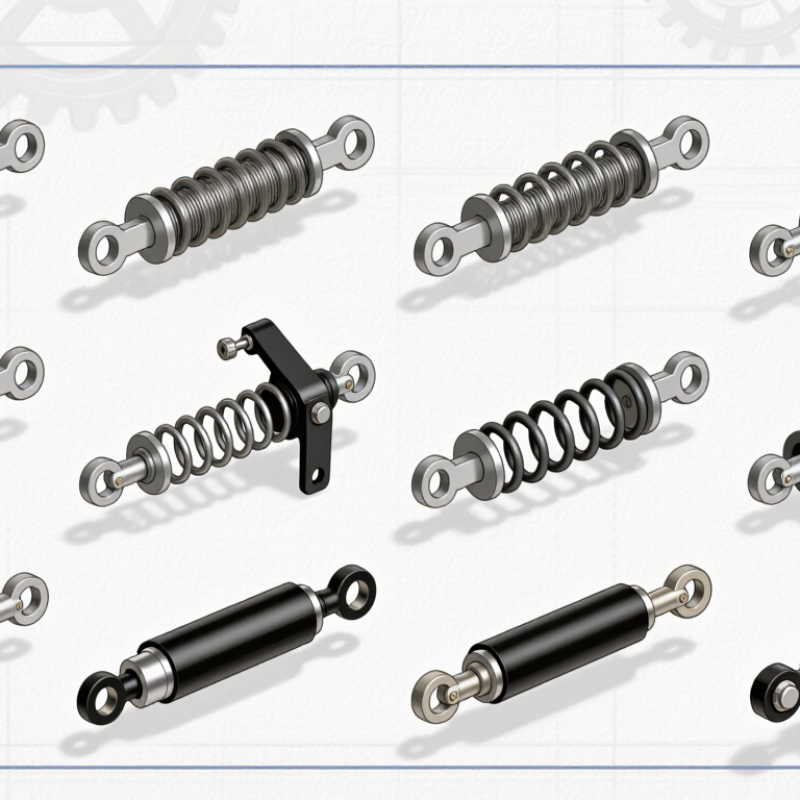
What Are the Top 10 Spring Tensioner Types?

Define Spring Tensioners by Load Path, Preload, Stroke, and Spring Rate

What Are the Top 10 Spring Tensioner Types?

Spring tensioners are best defined by four questions: Where does the load travel? How much preload is required? What stroke is available? How quickly does force rise? In practical designs, ten common configurations include extension-spring, compression-spring, torsion-spring, constant-force, clock-spring, gas-assisted, elastomer-assisted, pivot-arm, linear-slider, and floating-idler tensioners. These names overlap because some describe the spring, while others describe the mechanism.

Load path should be checked before selecting a part. A pivot-arm tensioner sends force through an arc, while a linear slider transfers force along one axis. A floating idler can absorb alignment changes, but it may wander under side loads. Preload keeps a belt, chain, cable, or webbing engaged at rest. Too little preload causes slack and vibration. Too much preload increases bearing wear. Stroke must cover the expected length change, including assembly tolerance and thermal growth. Spring rate controls force variation across that stroke. A high rate reacts firmly but may create shock. A low rate moves smoothly, yet it can lose tension under changing loads.

Tips: Measure the real load path, not the drawing alone. Record minimum and maximum tension during operation. Check spring rate near both stroke limits. I often find that the first estimate is too optimistic. Leave room for wear, contamination, and imperfect alignment. A short test with a force gauge can reveal more than a polished calculation. Also question whether the chosen “type” matches the mechanism, because terminology is not always consistent across engineering teams.

Classify 10 Types: Compression, Extension, Torsion, Gas, Hydraulic, and More

What Are the Top 10 Spring Tensioner Types?

Spring tensioners maintain controlled force when belts, chains, cables, or moving assemblies change length. In maintenance work, compression springs push components together, while extension springs pull them apart. Torsion springs create rotary force around a pivot. These three are common, but each needs careful load and fatigue assessment.

Other useful types include conical springs, which handle changing loads; disc or Belleville springs, which provide high force in compact spaces; and wave springs, which fit short axial areas. Gas tensioners use pressurized gas for smoother movement. Hydraulic tensioners use fluid pressure and damping. Elastomeric tensioners rely on rubber-like materials for quiet, flexible adjustment. Constant-force springs deliver nearly steady pulling force. Some designs combine spring force with hydraulic control. Strictly speaking, gas and hydraulic units are not traditional springs, but engineers often classify them as spring-assisted tensioners.

Tips: Check the working stroke, preload, temperature range, corrosion exposure, and cycle frequency before selection. Measure the actual tension, not only the catalog rating. Mounting alignment matters. Small angular errors can create uneven wear. I have seen a correctly sized spring fail early because its guide was rough. That detail is easy to overlook. Recheck assumptions during inspection, because real assemblies rarely behave perfectly.

Compare Force, Deflection, Fatigue Life, and Cycle Ratings in N, mm, and N/mm

Spring tensioners differ sharply in force, deflection, fatigue life, and cycle ratings. The ten common types include helical extension, compression, torsion, constant-force, garter, wave, Belleville, disc, clock, and gas springs. A helical extension spring may deliver 20–500 N across 10–80 mm, while its rate often falls near 0.3–8 N/mm. Constant-force springs provide nearly steady force, but their travel rating depends heavily on strip stress and winding diameter.

The Spring Manufacturers Institute Spring Design Manual links spring rate directly to load divided by deflection, measured in N/mm. ISO 10243 testing for die springs commonly evaluates force at defined working lengths, while EN 13906-1 supports calculations for helical spring stress and fatigue. In practical testing, compression and extension designs may reach 100,000–1,000,000 cycles when stress remains controlled. Torsion and clock springs can exceed 1,000,000 cycles, but only with modest angular deflection.

Numbers can mislead.

A tensioner rated at 300 N may lose useful performance if installation stretches it beyond its working range. Fatigue data from ASTM E466-style testing also shows that surface finish, temperature, corrosion, and side loading change cycle life. Belleville stacks offer high force in short deflection, sometimes above 1,000 N within 1–5 mm. Wave springs provide lower force, often 50–800 N, with compact travel. These figures are engineering ranges, not guarantees. Real assemblies need measured force-deflection curves, not catalogue optimism.

Top 10 Spring Tensioner Types: Force, Deflection, Stiffness, and Fatigue Life

The chart compares representative engineering values for ten common spring tensioner types. Force is shown in N, deflection in mm, stiffness in N/mm, and fatigue life as rated cycles. Values are typical design-reference figures and can vary with material, geometry, temperature, preload, and operating stress.

Apply ISO 606 Chain Dimensions and Belt-Tension Measurement Criteria

What Are the Top 10 Spring Tensioner Types?

Spring tensioners keep chains and belts engaged when vibration, wear, or thermal movement changes the drive length. Common designs include compression-spring, extension-spring, torsion-spring, constant-force, wave-spring, disc-spring, pivot-arm, sliding-base, roller, and shoe tensioners. Each type suits different space, travel, and load conditions. A compact wave spring may fit a narrow assembly. A pivot-arm tensioner can follow longer belt movement.

For chain systems, ISO 606 dimensions should guide the selection process. Check pitch, roller diameter, inner width, plate height, and chain length before choosing the tensioner. The tensioner must contact the chain correctly, without rubbing the side plates. Measure the slack span after installation. A simple ruler and controlled force can reveal excessive movement. It is not perfect, but it is useful.

Belt-tension measurement needs more discipline. Use the specified span length, deflection distance, and applied force for the belt design. Some maintenance teams also verify tension through vibration frequency. Keep the belt temperature stable, because heat changes its measured behavior. Check alignment and pulley condition before adjusting spring preload. More preload is not always better. It can overload bearings and accelerate belt wear. In field work, I often recheck the reading after a short run-in period. That extra check matters. Even experienced technicians can mistake mounting friction for correct tension.

What Are the Top 10 Spring Tensioner Types? - Apply ISO 606 Chain Dimensions and Belt-Tension Measurement Criteria

Spring Tensioner Type Operating Principle Typical Application ISO 606 Chain Considerations Belt-Tension Measurement Criterion Main Design Advantages and Limits
Compression-Spring Idler A compression spring pushes an idler pulley or sprocket against the slack side of a belt or chain. Compact chain drives, conveyor take-ups, and auxiliary belt drives. Choose an idler that matches the chain pitch, roller diameter, and inner width. The tensioner should normally act on the slack span and avoid forcing the chain beyond its allowable articulation. Measure the belt span force at a specified deflection. Accept the installation only when the measured force falls within the calculated or equipment-specified range. Simple and compact. Spring force can rise as compression increases, so travel and preload must be controlled.
Extension-Spring Tensioner An extension spring pulls a pivoting arm, pulley, or sprocket into the slack span. Long-center-distance belt drives, light conveyors, and mechanisms requiring external adjustment. Use a sprocket with tooth geometry and pitch compatible with the selected ISO 606 chain. Verify that the spring stroke can absorb expected chain elongation. Check static belt tension with a force-versus-deflection method or a calibrated tension gauge. Recheck after initial running because belts may settle during installation. Provides useful travel and easy visual inspection. Repeated cycling can cause fatigue if the spring is overextended.
Torsion-Spring Pivot Arm A torsion spring applies torque to a pivot arm carrying an idler pulley or chain sprocket. Timing belts, roller chains, compact automotive-style drives, and guarded machinery. Position the sprocket so the chain engages correctly without side loading. The arm range should accommodate pitch-line changes caused by wear and elongation. Measure belt force at the specified span deflection while the arm is in its operating position. The torque-angle relationship should be checked if the tension varies significantly through the travel. Good packaging and controlled motion. Pivot friction and arm geometry can make actual tension differ from nominal spring torque.
Constant-Force Spring Tensioner A pre-stressed strip spring supplies an approximately constant pulling force over much of its extension range. Long-travel belt tensioning, compact take-up systems, and applications with substantial center-distance variation. Use a chain sprocket sized for the ISO 606 pitch and roller dimensions. Confirm that the available force remains sufficient for the chain load at the full take-up position. Use a frequency meter or calibrated force gauge and compare the reading with the specified operating tension. A constant-force spring does not eliminate the need to verify belt pretension. Maintains relatively uniform tension over long travel. Limited force capacity and sensitivity to incorrect winding or mounting.
Leaf-Spring Tensioner A curved or flat spring element deflects to press an idler or guide against the slack span. Low-profile conveyors, light chain drives, and machinery with restricted radial space. The guide or sprocket must suit the chain width and roller diameter. Avoid contact with chain plates unless the component is specifically designed as a wear guide. Measure belt tension using a defined deflection distance and force. Inspect for permanent set if the measured force decreases after repeated cycling. Very low profile and few moving parts. Deflection, fatigue life, and alignment are strongly dependent on material and mounting geometry.
Disc-Spring Tensioner Stacked conical disc springs generate axial force that moves an idler assembly or take-up screw. High-load chain drives, industrial belt tensioners, and applications requiring high force in limited space. Match the chain sprocket to the ISO 606 pitch and roller dimensions. Use a positive stop to prevent excessive chain tension and bearing overload. Measure the resulting belt tension after the disc stack reaches its intended working position. Force-displacement calibration is recommended because stack arrangements alter spring rate. High force density and adjustable spring rate. Friction, stack tolerances, and incorrect washer orientation can affect repeatability.
Wave-Spring Tensioner A wave-shaped spring provides axial compression in a short axial package. Small belt drives, compact chain mechanisms, and bearing-mounted idler assemblies. Ensure that the sprocket width and chain side clearances correspond to the ISO 606 chain size. Axial spring force must not introduce harmful side loading into the chain or sprocket. Verify tension with a calibrated force gauge or frequency measurement. The measured value should be taken at the specified temperature and belt span condition. Efficient use of axial space and suitable for moderate loads. Limited travel and lower energy capacity than many helical springs.
Helical Compression-Spring Plunger A guided compression spring pushes a sliding plunger, shoe, roller, or idler toward the belt or chain. Modular conveyors, printed machinery, packaging equipment, and adjustable guide systems. Use a roller or sprocket compatible with the selected ISO 606 chain dimensions. The plunger should remain guided to prevent skewed chain engagement or belt tracking errors. Set the plunger preload, then measure belt tension at the working deflection. Confirm that friction in the guide does not prevent the tensioner from responding to belt length changes. Easy to manufacture and service. Guide friction, contamination, and spring buckling can reduce tension consistency.
Nested or Dual-Rate Spring Tensioner Two or more springs are arranged in parallel or in series to create a progressive or staged force curve. Drives exposed to variable loads, shock loading, or a wide range of belt and chain length changes. Size the ISO 606 chain sprocket for the correct pitch, roller diameter, and inner width. The total spring force must control slack without exceeding the chain's permissible working load. Measure belt tension at more than one arm or plunger position because the force curve is intentionally non-linear. Use the operating range rather than a single nominal value. Can combine compliance with high end-of-stroke force. More components increase calibration and maintenance requirements.
Spring-Loaded Eccentric Tensioner A spring biases an eccentric hub or cam so that rotation changes the center distance and maintains tension. Timing belts, compact power-transmission assemblies, and adjustable chain-drive frames. When used with a chain, the eccentric-mounted sprocket must maintain correct pitch-line alignment and sufficient tooth engagement for the applicable ISO 606 chain. Lock the eccentric at the prescribed setting, then verify belt tension using frequency, force-deflection, or a calibrated tension gauge. Recheck after tightening because fastener torque can change the setting. Offers adjustment and spring compliance in one assembly. Clamping security, eccentric runout, and alignment must be carefully controlled.

Selected ISO 606 Roller Chain Reference Dimensions

ISO 606 Chain Designation Pitch, p Roller Diameter, d1 Minimum Inner Width, b1 Tensioner Selection Use
06B 9.525 mm 6.35 mm 5.72 mm Use these dimensions to check sprocket compatibility and clearance for a small chain tensioner.
08B 12.700 mm 8.51 mm 7.75 mm Common reference size for compact industrial chain mechanisms and conveyor tensioners.
10B 15.875 mm 10.16 mm 9.65 mm Check the idler sprocket tooth form, chain clearance, and bearing capacity before selection.
12B 19.050 mm 12.07 mm 11.68 mm Suitable as a reference for medium-duty chain tensioner sizing and guard clearance.
16B 25.400 mm 15.88 mm 17.02 mm Requires adequate sprocket width, structural stiffness, and bearing capacity for the larger chain envelope.

Measurement note: ISO 606 specifies dimensional requirements for roller chains and does not define a universal spring force or belt pretension value. Belt tension should therefore be compared with the applicable equipment design range using a calibrated frequency meter, force-deflection method, or tension gauge. Values are normally recorded in newtons (N), hertz (Hz), or force per unit width where applicable.

Select Each Type by Load Range, Temperature, Space, Speed, and Maintenance Needs

Spring tensioners differ sharply in load range, temperature tolerance, installation space, speed, and maintenance demand. The ten practical types are compression, extension, torsion, constant-force, clock, die, wave, Belleville, conical, and garter springs. Compression springs suit moderate loads and repeated movement. Extension springs provide pulling force but need secure hooks. Torsion springs fit rotating joints. Constant-force and clock springs save space while delivering steady travel. Die, Belleville, and conical springs handle high loads in compact assemblies. Wave springs reduce axial height. Garter springs support rotating seals and tensioning rings.

Temperature changes can weaken unsuitable materials. For high heat, engineers commonly review alloy limits and fatigue data under ASTM and ISO testing methods. The 2024 Industrial Automation Market report by Grand View Research estimated the market at over 200 billion US dollars, with strong growth through 2030. That growth increases demand for compact, fast-cycle tensioning hardware. Yet speed creates friction, heat, and fatigue. A spring rated for static load may fail during rapid cycling. This detail is often missed.

Tips: Match the spring’s working load, not its maximum load. Check stroke, preload, solid height, and cycle frequency. Leave clearance around wave and Belleville springs. For dusty equipment, choose designs that allow visual inspection. The U.S. Department of Energy reports that compressed-air systems can lose 20–30% of capacity through leaks, reminding us that tensioning errors also waste energy. I would not select a type from a catalog alone. Real alignment, temperature spikes, and maintenance access can change the decision.

Top