Learn More With Our

Blog

What Are the Top Auto Shaft Types in 2026?

Auto Shaft selection in 2026 reflects two forces: global vehicle production and changing powertrain designs. OICA reported 93.5 million motor vehicles produced worldwide in 2023, a useful measure of the industry’s manufacturing scale. The International Energy Agency’s Global EV Outlook 2024 projected electric-car sales would reach about 17 million that year, exceeding one in five cars sold globally. These figures do not predict shaft demand directly. They show why engineers and buyers must consider both volume and vehicle architecture.

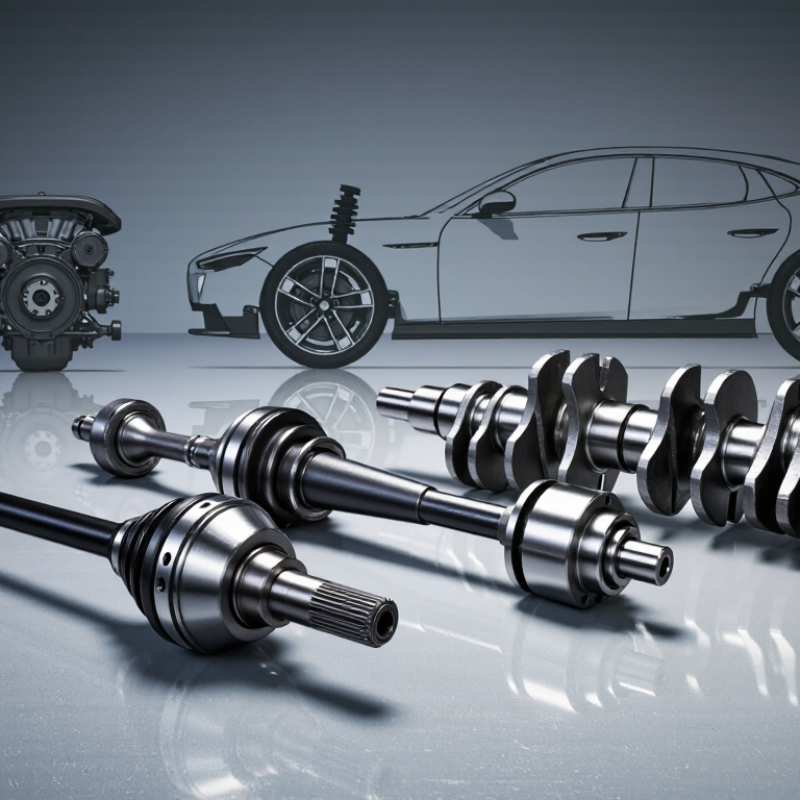
The main types serve different jobs. Drive shafts carry torque from the transmission or differential to the wheels. Axle shafts connect the differential to driven wheels, while steering shafts transmit driver input through the steering system. Engine designs also use crankshafts and camshafts, each with distinct motion and load requirements. Materials, joint design, length, and operating speed affect performance. A shaft suited to a rear-wheel-drive pickup may not suit a compact electric vehicle.

That distinction matters. For 2026, this guide compares common Auto Shaft types by function, configuration, and typical application. It also considers how electrification changes component layouts, without assuming every electric vehicle uses the same design. One caution: market reports often group components differently, so published market-size estimates can be hard to compare. Vehicle specifications and manufacturer documentation remain essential checks when choosing a shaft. A label alone is not enough.
What Are the Top Auto Shaft Types in 2026?

How Automotive Shafts Transfer Motion and Torque

An automotive shaft does more than spin. It carries torque between components while tolerating vibration, heat, and changing loads. The crankshaft turns piston motion into rotation; transmission input and output shafts carry that rotation through selected gear ratios. A propeller shaft then sends torque toward the differential, while half-shafts deliver it to the wheels. Small parts. Heavy work.

The details change with the drivetrain. A rear-wheel-drive propeller shaft may be long and hollow to reduce mass, while a front-drive half-shaft needs joints that follow steering and suspension movement. Electric vehicles still use shafts, though their torque paths differ. The IEA’s Global EV Outlook 2024 reports nearly 14 million electric-car sales in 2023, about 18% of global car sales. That shift makes shaft design increasingly varied, not obsolete. Engineers must account for peak torque, shaft angle, fatigue, and packaging—not just rated power. A clean diagram can make this look simple. Real roads are less tidy, and small alignment errors can matter.

Which Drivetrain Shafts Carry Power to the Wheels

What Are the Top Auto Shaft Types in 2026?

Which Drivetrain Shafts Carry Power to the Wheels

In a front-wheel-drive car, two half-shafts carry torque from the transaxle to the front hubs. Their CV joints bend as suspension moves and wheels steer, while protective boots keep grease in and grit out. Small parts matter. A torn boot can release grease; clicking on tight turns deserves inspection, though other faults can make similar sounds.

Rear-wheel-drive layouts usually add a propeller, or drive, shaft between the transmission and rear differential. It spins along the vehicle’s length, and axle shafts carry torque from the differential to the wheels. Universal joints or flexible couplings accommodate movement. A dented tube or worn joint may cause speed-related vibration. Do not diagnose from vibration alone.

All-wheel-drive vehicles combine these paths, using a prop shaft to feed another axle and half-shafts at driven wheels. Many electric drivetrains package a motor, gearing, and differential in an e-axle, but output shafts still connect to wheel hubs. Naming varies by design, and diagrams can be confusing. Check service information for the exact layout before ordering parts.

How Axle and Half Shafts Connect Wheels to the Drivetrain

In 2026, “auto shaft” can describe several parts, but axle shafts and half shafts are the direct links between a differential and driven wheels. A half shaft usually serves one wheel in an independent suspension setup. Power travels through the shaft while the wheel moves over bumps or turns. Small CV joints at its ends help maintain smooth rotation as angles change. The distinction matters. Parts catalogs sometimes use “axle shaft” and “half shaft” differently, so check the vehicle’s layout before identifying a replacement.

Front-wheel-drive cars commonly use two half shafts connected to the transaxle. Many all-wheel-drive vehicles use additional shafts to deliver power to rear wheels. Their CV boots are worth inspecting: a split boot can let grease escape and grit enter. A faint clicking sound during a tight turn may deserve attention, though it does not prove the shaft is faulty. Diagnosis takes more than a guess.

Solid axle shafts work differently. They connect wheel hubs to a shared axle assembly, often combining structural support with torque transfer. In some designs, semi-floating and full-floating layouts affect how the shaft carries vehicle weight. A propeller shaft is another common type, but it transfers power between the transmission and a differential, not straight to each wheel. These names can blur together. The useful question is where the shaft sits, what it connects, and how much movement its joints must handle.

What Crankshafts and Camshafts Do Inside the Engine

What Are the Top Auto Shaft Types in 2026?

What Crankshafts and Camshafts Do Inside the Engine

Inside an engine, the crankshaft and camshaft perform different jobs that must stay precisely coordinated. The crankshaft turns the pistons’ up-and-down movement into rotational force, which ultimately helps drive the vehicle. Its journals ride on lubricated bearings, so clean oil and correct clearances matter. A worn bearing can cause knocking or vibration, but those symptoms need proper diagnosis.

The camshaft operates the intake and exhaust valves through shaped lobes. Their timing determines when fresh air enters and exhaust gases leave each cylinder. A timing belt, chain, or gear system links camshaft motion to the crankshaft. Even a small timing error can affect performance, and in some engines, cause serious internal contact. The distinction sounds simple; actual engine layouts can make it less tidy.

How Transmission and Steering Shafts Support Vehicle Operation

Auto shafts turn engine power and driver input into controlled motion. In the transmission, input and output shafts carry torque through selected gear ratios. A propeller, or driveshaft, then sends power toward the differential, often beneath the vehicle floor. Its joints must tolerate angle changes as the suspension moves. In front-wheel-drive layouts, half-shafts and constant-velocity joints deliver torque while allowing the wheels to steer and rise over bumps. Small details matter.

Steering shafts do a different job. They connect the steering wheel to the steering gear, translating hand movement into wheel direction. Universal joints or flexible couplers help route the shaft around cabin structures and accommodate slight misalignment. Many designs also include a collapsible section intended to reduce intrusion during a severe impact. That feature depends on correct assembly; a bent shaft or loose coupling can create play, noise, or uneven steering response.

Inspection should follow symptoms and vehicle specifications, not guesswork. A technician may check joint looseness, damaged boots, corrosion, fastener condition, and unusual vibration under load. Road feel can be misleading: tire imbalance may resemble a shaft fault, while a worn joint may click only during a tight turn. Diagnosis takes patience. Shaft designs vary by drivetrain and suspension geometry, so replacement dimensions and joint angles must match the application. Even a small mismatch can shorten service life.

Article Source:

Top