What Is an Indoor Acoustic Wall Panel?
An Indoor Acoustic Wall Panel is a wall-mounted element designed to absorb some sound energy inside a room. It commonly combines a porous core, such as mineral fiber or recycled polyester, with fabric, wood, or another protective facing. Exact construction varies by product. That matters. Unlike a sound barrier, a panel usually does not block all sound from passing between rooms. Its main role is to reduce reflections that can make voices seem sharp, distant, or muddy. In a meeting room, a few panels near reflective walls may help speech feel clearer. Results depend on room size, surface coverage, panel thickness, and placement. One panel rarely fixes everything.
This guide explains how these panels work, where they are useful, and what to check before choosing one. Look beyond color and shape. Review absorption data, fire and care information, mounting requirements, and the maker’s installation guidance. If possible, assess the room while people are speaking; an empty room can sound different. A panel may improve comfort, but it cannot correct every source of noise. And expectations matter. Product ratings are useful, yet they do not replace a practical assessment of the actual room. Choosing well means matching the panel to the problem, not simply covering a wall. The details can be less tidy than a catalog suggests.
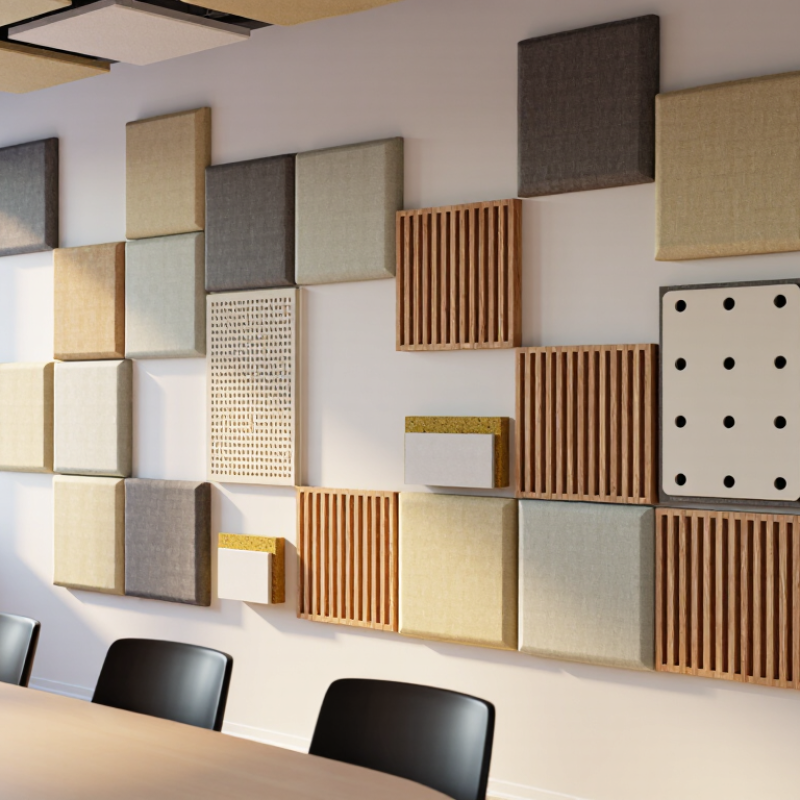
Definition and Purpose of an Indoor Acoustic Wall Panel
An indoor acoustic wall panel is a sound-absorbing material fixed to a room’s walls. Its purpose is to reduce sound reflections, helping speech stay clearer and limiting distracting reverberation. Common cores include porous mineral fiber or recycled polyester, covered with fabric. In a meeting room, panels might sit near seated ear height, where voices reflect between parallel walls. They absorb some sound energy; they do not block all noise from neighboring rooms. Still, panels are not magic.
The benefit depends on the room’s size, surfaces, and panel placement. The ANSI/ASA S12.60-2010/Part 1 classroom acoustics standard sets a reverberation-time limit of 0.6 seconds for furnished, unoccupied learning spaces up to 10,000 cubic feet. It allows up to 0.7 seconds for spaces between 10,000 and 20,000 cubic feet. These figures offer a useful reference, not a universal target for every home or office. A panel’s Noise Reduction Coefficient, measured under ASTM C423, can help compare sound absorption, but it does not describe soundproofing.
Practical assessment matters. A hard, empty room with glass, tile, and exposed concrete may need more absorption than a carpeted room with curtains and bookshelves. Panels placed only behind a speaker may leave strong reflections elsewhere. Measure the space, note where speech sounds harsh, and check product test data before choosing coverage. Even then, results can be uneven; room shape and installation details matter.
How Acoustic Wall Panels Absorb and Control Sound
What Is an Indoor Acoustic Wall Panel?
How Acoustic Wall Panels Absorb and Control Sound
An indoor acoustic wall panel is a sound-absorbing surface fitted to a room’s wall. Many panels use porous materials, such as mineral fiber or dense foam, beneath a fabric or perforated finish. When sound waves enter the material, tiny air movements lose energy through friction. Less sound returns to the room as an echo. The effect is often easiest to notice during speech: words sound clearer, and sharp reflections feel softer.
Placement matters. In a meeting room, panels near wall reflection points can reduce distracting bounce between speakers and listeners. In a home office, a few panels behind a desk may help tame voice reflections during calls. Thicker panels, sometimes installed with an air gap, can absorb a broader range of frequencies than thin coverings.
Still, panels mainly control reflections inside a room; they do not reliably block noise passing through walls. That distinction is easy to miss.
Results also depend on room size, panel coverage, furniture, and sound sources. A room may feel less harsh but still have uneven bass. Measure, listen, and adjust—the first layout is rarely perfect.
Key Materials and Construction Features
What Is an Indoor Acoustic Wall Panel?
Key Materials and Construction Features
An indoor acoustic wall panel absorbs room reflections; it does not automatically block sound passing through a wall. Common cores include mineral wool, glass fiber, and recycled PET felt. Their open, porous structure lets sound enter and lose energy through friction. A fabric face needs to remain acoustically permeable, while a rigid frame keeps the panel flat and securely mounted. Small details matter.
ASTM C423 test reports calculate the Noise Reduction Coefficient from absorption measurements at 250, 500, 1,000, and 2,000 Hz, rounded to the nearest 0.05. ISO 354 also specifies reverberation-room measurement. These laboratory figures help compare products, but they do not guarantee the same result in every room. Panel thickness, an air gap behind it, placement, and room furnishings all affect performance. Perforated wood or metal faces can work with an absorbent backing and cavity. Not a soundproof wall. That distinction is easy to miss.
Tips: Check the full test report, not just the headline rating. Match panel construction to the room’s main problem, and verify fire and emissions documentation. If possible, test one panel in the actual space; a small trial can reveal an awkward fit or unexpected reflection.
Common Panel Types and Indoor Applications
An indoor acoustic wall panel is designed to absorb some sound energy and reduce reflections inside a room. It can make speech clearer, but it does not soundproof a space. Fabric-wrapped panels often contain mineral fiber or recycled polyester. Wood-slat panels pair a decorative surface with an absorptive backing. Perforated wood or metal panels can also help control reflections. Foam panels are lightweight, though their appearance and performance vary.
Panel types suit different indoor settings. In a home office, a few fabric panels near a desk can soften calls and reduce room echo. Classrooms may use durable panels on side or rear walls, where voices otherwise bounce back. Dining rooms often benefit from discreet panels that temper clatter without changing the room’s character. Recording spaces need more careful placement. More coverage is not always better.
Tips: Start with the loudest problem area. Clap once and listen for a sharp flutter or lingering echo. Place panels near early reflection points, such as the wall beside a work desk. Check the panel’s published absorption data, and match it to the frequencies you need to manage. Leave room for doors, vents, and artwork. A small test area can reveal an awkward color or placement before you install more.
What Is an Indoor Acoustic Wall Panel?
Common panel types and their typical sound-absorption performance
Acoustic wall panels absorb sound to help reduce reflections and reverberation indoors. NRC (Noise Reduction Coefficient) is a rounded measure of sound absorption, from 0 (very little absorption) to 1 (high absorption). The values shown are representative benchmarks, not guaranteed ratings: actual performance varies with product, thickness, air gap, and installation. Check laboratory data for a specific panel.
Factors to Consider When Choosing a Panel
An indoor acoustic wall panel absorbs part of a room’s reflected sound; it does not block sound like a barrier. Choose one for the room’s actual problem. Is speech hard to follow, or does the room feel harsh when chairs scrape? These clues point toward reverberation control. The U.S. EPA’s 1989 Report to Congress on Indoor Air Quality notes that people spend about 90% of their time indoors, making everyday room comfort worth considering.
Check the panel’s Noise Reduction Coefficient (NRC), measured under ASTM C423. NRC averages absorption at 250, 500, 1,000, and 2,000 Hz, then rounds the result to the nearest 0.05. An NRC of 0.80 suggests strong average absorption across those test frequencies, not equal performance at every pitch. Ask for the full frequency-by-frequency test data, typically measured using a reverberation-room method such as ISO 354. A single rating can hide weak low-frequency performance.
Match the material and coverage to the room. A meeting room with glass walls may need more absorption than a carpeted study. Check panel thickness, mounting gap, cleanability, and resistance to dents near busy walkways. Leave some hard surfaces where useful; an overly “dead” room can feel unnatural. Test a small area first, if possible. It is not a perfect prediction, but listening from the seats people actually use can reveal what a specification sheet misses.


